
I Didn't Know to Be Thankful
I Didn't Know to Be Thankful
“Be thankful in all circumstances, for this is God's will for you who belong to Christ Jesus.”
— 1 Thessalonians 5:18 (NLT)
I've read that verse before. I've talked about gratitude. I've thanked God for my family, my health, my work, our home, food on the table, and all the obvious blessings we tend to count.
But lately I've realized there was an entirely different list of things I should have been thankful for.
I just didn't know.
I didn't know to be thankful for health insurance—because I had never really understood what it meant to need it over, and over, and over again. And honestly, I never imagined what it would be like to meet our entire annual deductible in the very first month of the plan year.
Most people spend the year hoping they won't have to use their insurance. We were just one month in, and we had already met the deductible. That's when you realize how quickly life can change and how something you considered just another monthly expense becomes an absolute necessity.
I didn't know to be thankful that when we walked into a hospital, nobody knew us. Because eventually we would check in and hear, “Welcome, Matthew.”
I didn't know to be thankful for needing directions in a hospital. Eventually, we didn't need them. We knew exactly how to get to MRI, infusion, the Neuro ICU, and just about everywhere else.
One of my ways of releasing stress during those long hospital visits was to power walk the halls and floors. I walked so much that I started making friends with the hospital staff along the way. Before long, I knew people on just about every floor, and they knew me. I practically fit in like a regular.
It's funny how a place you never wanted to become familiar with can eventually feel like a second home. Not because you want to be there, but because you've spent so much time there that even the unfamiliar becomes familiar.
Looking back, I didn't know to be thankful for the days when I could walk into a hospital and be a complete stranger.
I didn't know to be thankful for sitting in a room waiting for a doctor to explain an MRI.
Eventually, I had seen so many of them that I could look at the images and have a pretty good idea what the doctor was going to say before he ever walked into the room.
Matthew had over 180 MRIs in an 18-month span.
Yes, you read that correctly. More than 180. That's an average of more than two MRIs every single week for a year and a half.
Brain MRIs, spine MRIs, with contrast, without contrast. I had seen so many images that I could look at a scan and generally recognize what was good news and what wasn't.
Now, I'm certainly no radiologist, and I never wanted to become an amateur one. But when you've sat through that many scans with your child, you start recognizing things no parent should ever have to recognize.
I never imagined I would reach a point in my life where I could look at an MRI of my son's brain or spine and know whether to feel relief or fear before the doctor even said a word.
I didn't know to be thankful that I had never needed to set up Google Alerts for NTRK gene fusions, cancer research, new treatments, and clinical trials.
I never imagined I would wake up every morning hoping there might be a new study, a medical breakthrough, or a clinical trial somewhere in the world that could help save my son's life.
Before Matthew's diagnosis, I couldn't have told you what NTRK stood for, much less explained how a gene fusion could affect cancer treatment. But suddenly, I was reading medical journals, researching experimental drugs, and following developments from researchers and cancer centers around the world.
It's amazing how quickly a parent can become obsessed with something they never even knew existed. Not because they want to become an expert, but because somewhere in all that research, you're praying there might be an answer.
And every time that Google Alert appeared, there was that little bit of hope.
Maybe this one. Maybe this is the breakthrough we've been praying for.
I didn't know to be thankful that I had never needed to read an eight-page lab report every single week, sometimes before the medical team even called.
Eventually, I knew what nearly every number meant. I knew the normal ranges, and when even one marker was out of line, I knew what it could mean for Matthew.
I had become pretty good at interpreting bloodwork. Not because I had any medical training, but because when it's your child, you learn things you never imagined you would need to know.
I didn't know to be thankful that I had never needed to understand why potassium was so important to the human body.
Who knew something we rarely think about could become such an important number on a lab report? I certainly didn't. But I learned quickly.
And here's a little side note that makes me smile.
We learned that foods like Raisin Bran cereal and certain meats, including wild game, could help provide potassium.
Well, that worked out pretty well for Matthew because he absolutely loved cooking whatever wild game he could get his hands on. Deer, aoudad, and just about anything else he could acquire. If he could hunt it, find it, or cook it, chances were he was going to give it a try.
And here's the part that makes me smile even more.
Matthew actually loved sharing what he was learning about potassium with his medical team.
Managing potassium through his diet wasn't something we had ever given much thought to, and suddenly we were all learning which foods seemed to help raise his levels and which ones didn't.
Matthew would proudly explain what he'd been eating, and the medical team would listen. In some ways, the doctors were learning right alongside him as they watched how his body responded.
Now, you're probably asking, “Why didn't he just take a potassium pill?”
Great question. He did!
For a few days, anyway.
But those pills were huge, and the side effects were horrible for him. Matthew decided pretty quickly that he wanted to find a more natural way to get his potassium levels where they needed to be.
And in true Matthew fashion, he did his research, figured out what worked for him, and took matters into his own hands—with his medical team keeping an eye on his lab results.
His solution?
Wild game and old-school cereal.
That's right. Deer, aoudad, and Raisin Bran became part of his strategy for keeping his potassium where it needed to be.
Only Matthew could turn something as serious as managing his blood chemistry into a conversation about hunting, cooking wild game, and breakfast cereal.
And he loved sharing what he learned.
I never imagined that one day I'd be sitting in a hospital room listening to my son explain to his doctors how deer meat and Raisin Bran were helping his potassium levels.
But there we were.
That's what cancer does. It turns ordinary parents into students of medicine, nutrition, and a thousand other subjects we never wanted to study.
And sometimes, in the middle of all that learning, you find little moments that still make you smile.
But not everything we learned came with a smile.
Some of the conversations were far more difficult.
I didn't know to be thankful that I had never discussed a DNR with my child.
And if you don't know what DNR stands for, consider yourself fortunate. It means Do Not Resuscitate.
It's a conversation no parent ever imagines having with their child. You're sitting there discussing whether medical professionals should attempt to restart your child's heart or breathing if either stops.
Think about that for a moment.
As parents, we spend our lives doing everything we can to protect our children, keep them safe, and help them live long, healthy lives.
And then one day, you're sitting across from your own child discussing what happens if their heart stops beating.
You know, looking back, I truly believe God was with Jennifer and me when we had that conversation with Matthew.
I don't know how else to explain it. As parents, every instinct you have tells you to protect your child, to fight for them, and to never give up. And yet, there we were, having a conversation that no parent should ever have to have.
Somehow, God gave us the strength to talk about something that seemed impossible to even say out loud.
He didn't make the conversation easy. He didn't take away the heartbreak or the reality of what we were facing. But I believe He gave us the peace and strength to get through it together.
Sometimes God's presence isn't found in a miracle that changes the outcome. Sometimes it's found in the strength He gives you to face an outcome you never imagined.
we prayed religiously for a miracle…….
And I believe He was sitting right there with the three of us.
I didn't know to be thankful for all the years when conversations with my son were about school, baseball, hunting, and his future—instead of whether he wanted to be resuscitated.
I do now.
I didn't know to be thankful that I had never needed to have that conversation.
I do now.
I didn't know to be thankful that I had never needed to ask my son what quality of life meant to him. You know, before all of this, when I heard the term quality of life, I thought about something completely different.
To me, quality of life was how nice the parks were in your city. How many miles of hike-and-bike trails were available. How pretty the landscaping was, how well the neighborhoods were maintained, and whether a community was a nice place to live and raise a family.
You know, the things you read about when a city is ranked as one of the “Best Places to Live in America.”
That was my understanding of quality of life.
Boy, did that definition change.
Suddenly, quality of life wasn't about parks, walking trails, or beautiful landscaping.
It was about my son.
Could he see? Could he walk? Could he talk? Could he hear? Could he feed himself?
Those are words we hear from time to time, but until you're sitting across from your own child discussing what kind of life he would or wouldn't want to live, I don't think you can fully appreciate how difficult that conversation can be.
And this wasn't some hypothetical discussion about what might happen 40 or 50 years down the road.
This was real. And these were decisions we had to discuss before Matthew underwent brain surgery.
What if you wake up and you're blind?
What if you can no longer walk?
What if you can't talk?
What if you can't hear?
What if you can no longer eat on your own?
What if you survive the surgery, but your life is forever changed?
These weren't questions any parent wants to ask their child. But they were real possibilities we had to confront.
Think about it. A surgeon is operating on your child's brain, where an incredibly small movement can mean the difference between preserving a function and permanently changing it.
One tiny movement could change everything.
And there we were, asking our son to think about what he would be willing to live with and what quality of life meant to him.
As a father, I wanted to tell him none of those things would happen. I wanted to promise him he would wake up, walk, talk, see, hear, and go right back to being Matthew.
But I couldn't make those promises.
All I could do was listen, make sure he understood the possibilities, and let him tell us what mattered most to him.
That's a different kind of parenting.
You're no longer talking about what college to attend, what career to pursue, or what dreams your child wants to chase.
You're talking about which abilities he might lose and what kind of future he could accept.
And the hardest part?
You would give anything to take his place on that operating table or carry that burden yourself. But you can't.
I didn't know to be thankful for all the years when Matthew's future was something we talked about with excitement instead of fear.
I do now.
And I can promise you one thing.
I'll never hear the words “quality of life” the same way again.
Those are words we hear from time to time, but until you're sitting across from your own child discussing what kind of life he would or wouldn't want to live, I don't think you can fully appreciate how difficult that conversation can be.
I didn't know to be thankful for medical records that were boring and uneventful.
I didn't know to be thankful for not knowing where things were in the hospital. Eventually, a doctor could ask the medical team for something, and I could say, “It's in room ___.”
Not because I worked there.
Because my familiarity with the exam rooms.
I didn't know to be thankful that I had never watched someone I loved ring the bell after cancer treatment.
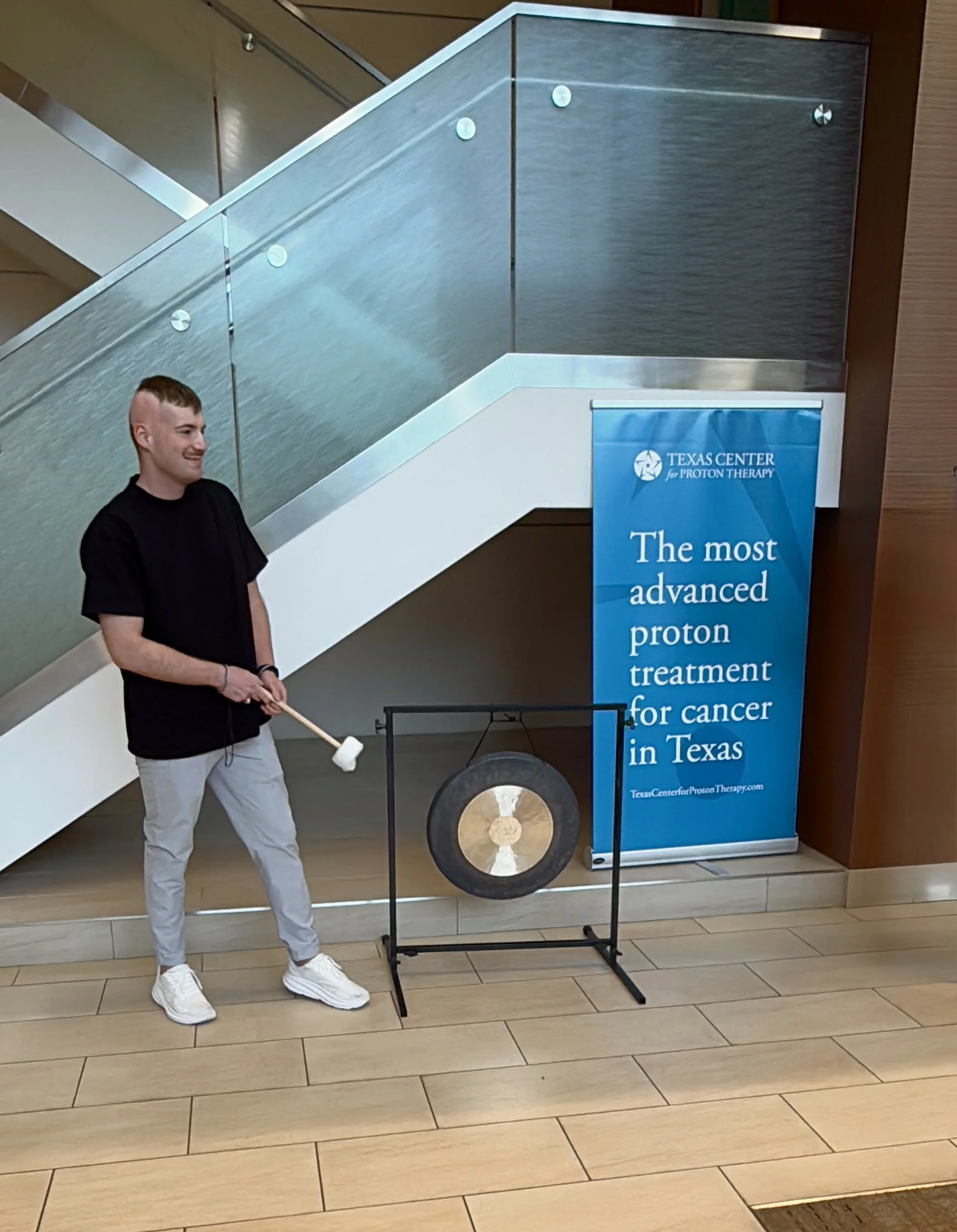
Celebrating the completion of Proton Therapy June 5, 2025
And then watched him ring it again.
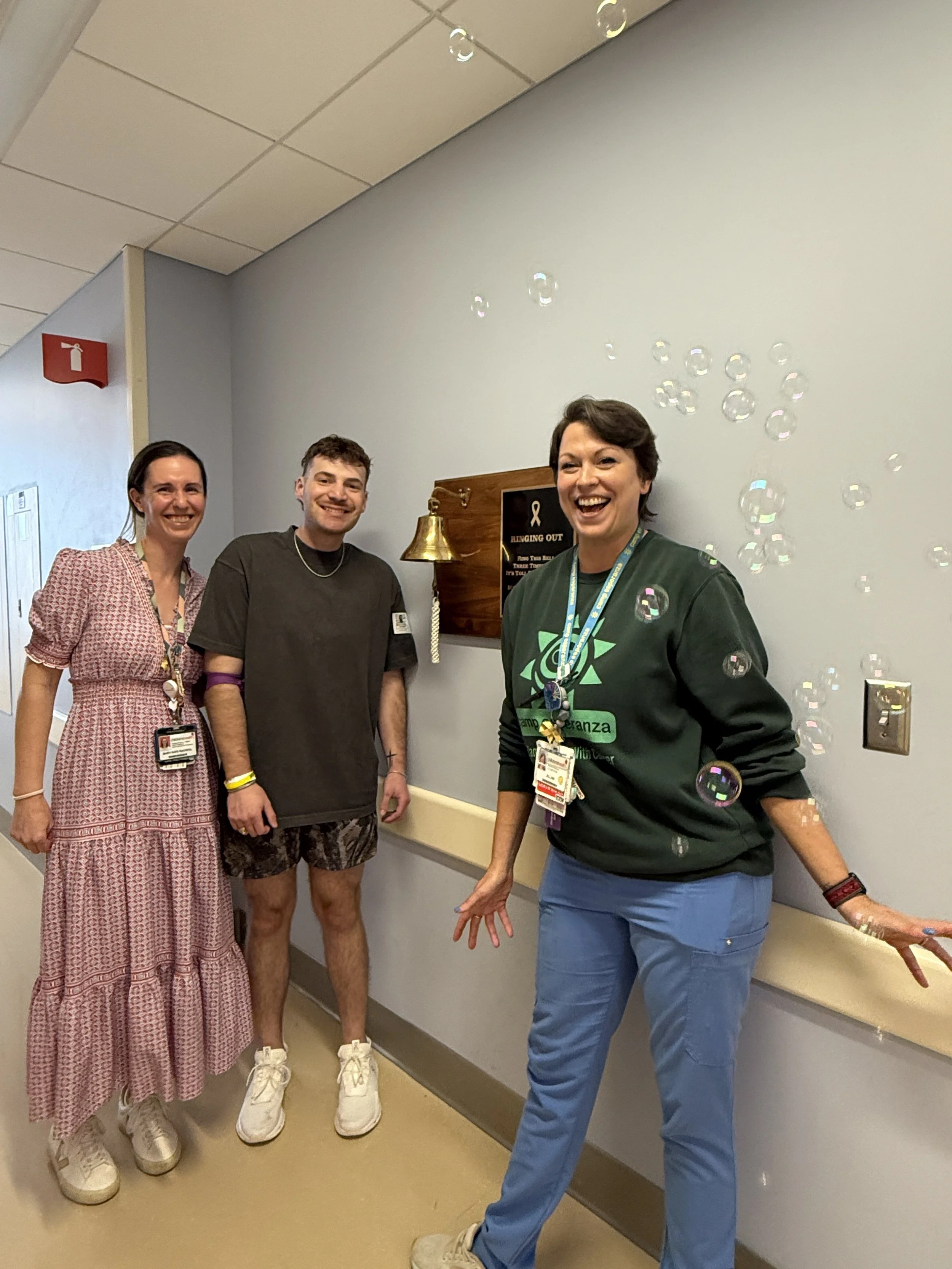
Matthew Ringing the Bell #2 after an amazing report. With his favorites from Children’s Medical Center Dallas. March 25, 2026
Matthew was proud to say that he beat cancer twice.
I believe he ultimately beat it a third time—just not in the way any of us wanted.
I've since learned that the bell is a complicated and sometimes controversial subject within the cancer community. That's a conversation for a future blog post.
I didn't know to be thankful that I had never needed to talk my child through the fear of a 12-hour brain surgery.
And I'll add to that—trying to be strong for my wife, Jennifer, our daughter, Macie, Matthew's grandparents, our family, and some of Matthew's closest friends.
As the dad, the father figure, you feel like you have no other choice but to be strong. Everyone is looking for reassurance. Everyone wants to believe it's going to be okay. And somehow, you're supposed to be the one who holds it all together.
But here's what they don't see.
Deep down, you're scared to death.
Because you know the reality. You understand the risks. And in our minds, it was literally a coin flip whether Matthew would wake up from that surgery.
Think about that for a moment.
You're trying to reassure your son that everything is going to be okay, while knowing there's a very real possibility that the last conversation you just had with him could be your last.
How do you prepare for that?
How do you look your wife and daughter in the eyes and tell them everything will be fine when you don't know that yourself?
You pray. You trust the medical team. You put on that brave face. And you do everything you can to keep everyone else from seeing just how terrified you really are.
Because sometimes being strong doesn't mean you're not afraid. It means you're afraid beyond words, but you keep going because your family needs you.
And as you know, Matthew did wake up.
I know God was right there with him, just as He was with him in that grassy field.
That grassy field is a story that will forever hold a special place in my heart. A reminder that even when I couldn't physically be beside my son, God never left him.
And looking back, I realize something else I didn't know to be thankful for.
I never knew to thank God for all the ordinary nights when I could simply tell my son goodnight without wondering whether I would ever hear his voice again.
I didn't know to be thankful that I had never spent time in a Neuro ICU.
I didn't know to be thankful that I had never needed to get a disability parking placard for my child.
And then came the things I never imagined I would have to face.
I didn't know to be thankful that I had never had to plan my child's funeral.
I didn't know to be thankful that I had never had to eulogize my son.
I didn't know to be thankful that I had never had to walk into my son's office and clean it out.
Not going to lie.
This one still hurts. A lot.
Matthew had just started with our company in May as our new Preconstruction Manager, and he was already making great strides. He was learning, contributing, bringing fresh ideas, and beginning to make his mark on the company.
His future was incredibly bright, and I was excited about what we were going to build together.
And here's the part that makes it even harder.
His office was right next to mine.
How fortunate was I as a dad? I had the opportunity to work alongside my son every day. Not just watch him grow up, graduate from college, and begin new career path, but actually be part of the journey.
We could walk next door, talk about a project, bounce ideas off each other, or just have one of those ordinary father-and-son conversations that I now realize were anything but ordinary.
I had envisioned years of working together. Watching him grow into a leader. Seeing him succeed. Maybe even watching him accomplish things I never could.
I thought we were just getting started.
And then, instead of watching him settle into his office and build his career, I found myself standing in that same office trying to figure out how to pack up his belongings.
Thankfully, Jennifer was right there beside me when we cleaned out Matthew's office. I don't know if I could have done that alone.
What made that evening especially meaningful was something his coworkers had done for us.
The team knew Jennifer and I were coming in that night to gather Matthew's belongings.
And before they left for the day, they had all left flowers for Jennifer.
Think about that. They also lost a coworker and friend.
In the middle of one of the hardest things we would ever have to do as parents, these wonderful people took the time to let us know they cared.
They knew there weren't any words that could make that evening easier, but they found a way to show their love.
We walked into that office knowing we had to pack up our son's things, and instead, we were reminded just how much he was loved by the people he worked with.
Those flowers didn't take away the pain. But they reminded us that we weren't walking through it alone.
And there's another thing I didn't know to be thankful for.
The kindness of people who somehow know what you need, even when you don't know what you need yourself.
And I certainly didn't know to be thankful that I had never had to hire someone to replace my son at our office.
Think about that for a moment.
As a business leader, I've hired hundreds of people over the years. I've filled positions, made staffing changes, and worked to build strong teams. That's part of running a business.
But this wasn't just another position to fill.
This was my son's position.
I wasn't replacing an employee who had moved on to another opportunity. I was filling a position left vacant because my son had died.
And as much as the business had to keep moving forward, a part of me wanted everything to stop.
Because the office next to mine wasn't supposed to be empty.
Matthew was supposed to be in it.
I didn't know to be thankful for the ordinary workdays when I could walk next door and see my son sitting at his desk or yell “MATTHEW”
I would give anything to have just one more of those days.
The Sixth Floor
This list could go on and on, but I think you get the point.
Because tonight, somewhere in a hospital—actually, in hospitals all over the world—parents are sitting beside their children hearing words they never dreamed they would hear.
Words like cancer.
Tumor.
Surgery.
Treatment.
Recurrence.
And sometimes words no parent should ever have to hear.
Some of the hardest moments of the past two years for me were the times we spent on the sixth floor of Children's Medical Center Dallas.
Not because of the people.
The people were amazing.
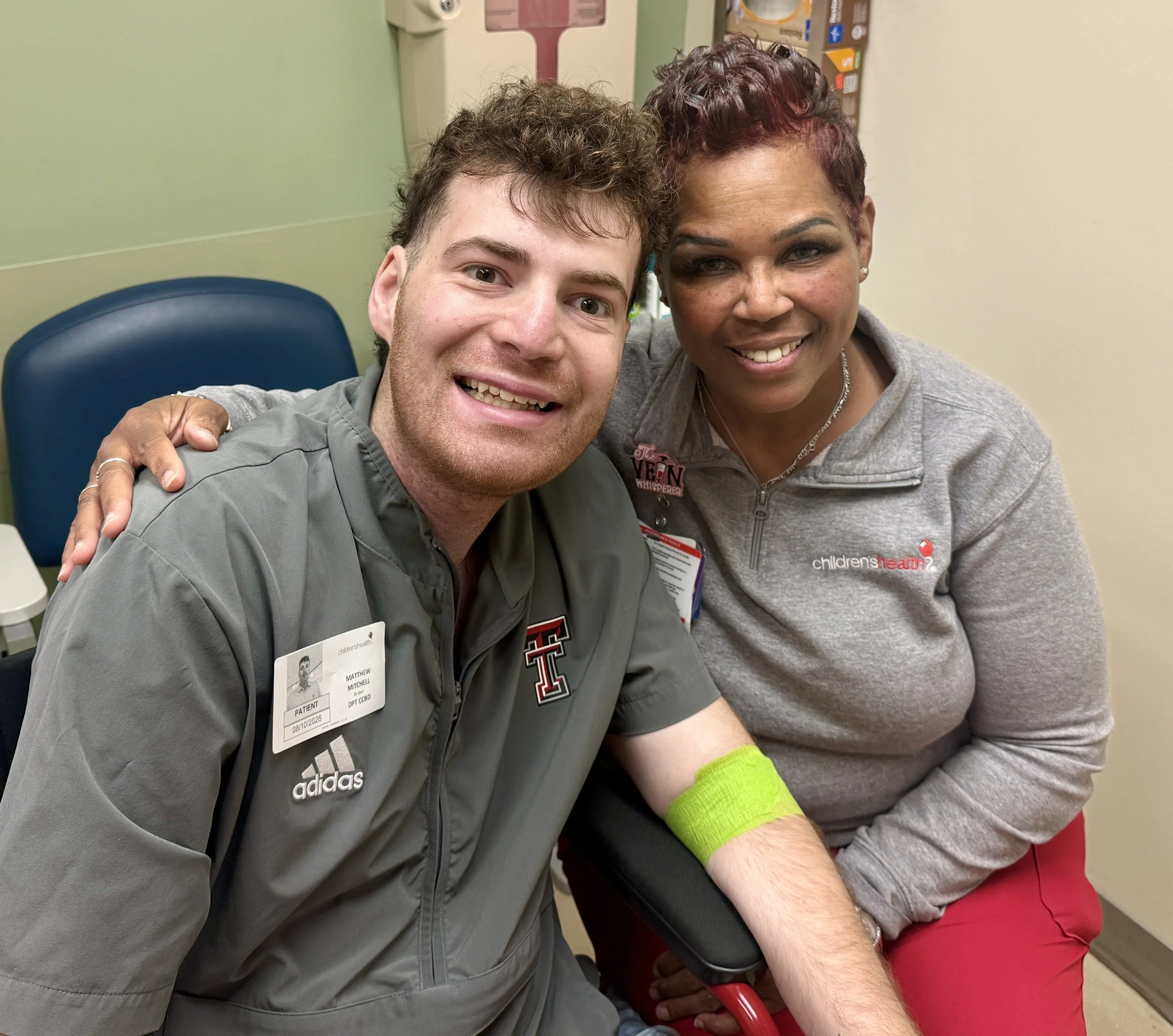
Matthew & Ms. Sharron, these 2 have a very special bond. Matthew referred to her as his “Twin Sister”
The sixth floor is where children battling cancer receive care, and the doctors, nurses, specialists, and medical teams caring for those kids are nothing short of angels.
What made that floor so difficult was looking around.
I will never forget the faces of the other parents.
Parents advocating for their children. Parents trying to understand medical terminology they never wanted to learn. Parents trying to be strong while watching their child fight cancer.
And then there were the really young parents.
Moms and dads pushing little kids down the hallway. Children so small that it seemed impossible they could already be fighting something so big.
That was hard for me.
Matthew was older. We could talk. We could reason through things together. I could explain what was happening, and he could tell me what he wanted, what he feared, what hurt, and what quality of life meant to him.
I'd look at those parents with very small children and wonder how they did it.
But they did.
Because that's what parents do.
You advocate. You learn. You ask questions. You pray. You sit beside the bed. You sleep in uncomfortable chairs. You become an expert in things you never wanted to know anything about.
And somehow you keep going.
I remember looking at those young parents and realizing that while our circumstances were different, we were all there for the same reason.
We loved our children, and we would have done anything in the world to make them better.
Those aren't things you put on a gratitude list.
Until they happen to you.
Learning to Be Thankful
Maybe that's part of what Paul meant when he wrote:
“Be thankful in all circumstances.”
He didn't say to be thankful for all circumstances.
I'm not thankful Matthew got cancer.
I'm not thankful for brain surgeries, MRIs, hospital rooms, wheelchairs, DNR conversations, hospice, or funerals.
And I will never be thankful that my son died.
But I'm beginning to understand that there were thousands of ordinary days before all of this that were incredible gifts from God—and I didn't recognize many of them as gifts because I assumed they would always be there.
There was a time when we didn't know our way around a hospital.
There was a time when an MRI was something that happened to somebody else's family.
There was a time when I didn't know what a DNR meant for my 22-year-old son.
There was a time when Matthew walked everywhere we went.
There was a time when his office was occupied by him.
There was a time when planning his funeral was an unimaginable sentence.
I didn't know to be thankful for any of it.
I do now.
And here's something else I've come to understand.
I don't have all the answers. I don't pretend to. And what gratitude looks like for me today may be completely different from what it looks like for you.
Some days, I'm thankful for the memories.
Some days, I'm thankful for the people God has placed in our lives.
Some days, I'm thankful for a simple act of kindness, like flowers left in an office.
And some days, I'm just thankful I made it through the day.
Maybe gratitude isn't always thanking God because everything is good.
Maybe sometimes gratitude is finally recognizing how much was good when we didn't even realize it.
And tonight, I'm also thinking about those parents sitting in hospital rooms who are just beginning a journey they never asked to take.
I pray for them.
I pray for their children.
And I pray that somewhere in the middle of the fear, the questions, the scans, and the waiting, they feel God sitting in that room with them.
Maybe that's my prayer for myself too:
God, thank You for all the things I knew to thank You for.
And thank You for all the things I didn't know to be thankful for.
Help me recognize the gifts that are still right in front of me today—before they become the things I wish I had appreciated yesterday.
Because sometimes the greatest blessings in our lives are the things we never thought to thank God for—until they were gone.
Faith According to Kevin
